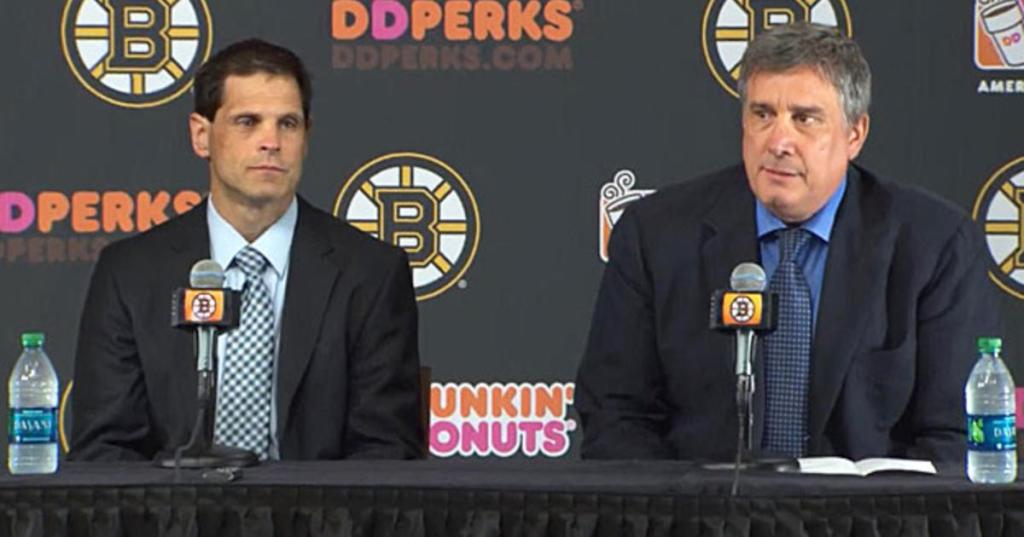
This is the season when speculation reaches a fever pitch. Yet, for NHL General Managers—including Don Sweeney—it remains just another strategic option in their arsenal.
The buyout period starts on June 15 or 48 hours after the Stanley Cup Finals conclude, whichever comes later, and runs until June 30. If a team has a player involved in salary arbitration—whether the contract is mutually settled or decided by an arbitrator—a second buyout window opens. This additional buyout window begins three days after the settlement or an award is handed down and remains available for 48 hours.
There are two key restrictions on the second buyout window: the player must have been on the roster at the last trade deadline and have an average annual value (AAV) of at least $4 million.
I’ll spare you the details on calculating a player’s buyout cap hit, but if you’re curious, our friends at PuckPedia have a handy buyout calculator you can check out.
The Bruins have a significant number of arbitration-eligible players—thirteen, to be exact. Before any player can file, the team must first extend a qualifying offer, which is due by 5:00 PM EDT on June 30. Players then have until July 5 to submit their arbitration filings. It’s hard to imagine the Bruins qualifying all thirteen, but the chances of at least one player filing seem high. And that would open a second buyout window.
Two names’ fans keep bringing up for a potential buyout: Joonas Korpisalo and Casey Mittelstadt.
Let’s begin with Korpisalo.
The buyout would result in the following cap hits: $541,667 for the 2025-2026 season, $1,291,667 in 2026-2027, and $1,666,667 in 2027-2028. From the 2028-2029 season through to 2030-2031, the cap hit would be $916,667 each season.
Some interpret his end-of-season remarks about wanting more playing time as a sign that he’s looking to leave Boston. While I don’t share that view, let’s consider the possibility for the sake of this discussion.
Why opt for a buyout? From a financial and cap perspective, the Bruins would be in a stronger position by retaining 33.3%—or $1 million—making him a more appealing trade asset. While this approach would add $458,333 to the cap for the 2025-2026 season compared to a buyout, it would lead to savings over the following five seasons. And since we’re only comparing financial impact, his potential replacement isn’t a factor in this discussion.
If the Bruins decide they need cap space for free agency, they’ll have to make a move with Korpisalo. I don’t see a buyout as a realistic option—I believe they’ll explore a trade instead. And he is not eligible for the second buyout window.
When it comes to roster moves, Sweeney tends to target players with term or those he believes he can re-sign—and Mittelstadt fits the former category. There must be something in the Bruins’ internal analytics that stands out to them, beyond what’s publicly available online to us fans. Otherwise, they wouldn’t have taken on his $5.75 million cap hit for the next two seasons.
In hockey, you can never rule anything out. If the Bruins were to land a couple of major free agents and needed to free up cap space, a buyout in the second window could be a viable option if a trade wasn’t possible. The cap hit for the upcoming season would be $1.5 million, clearing $4.25 million in space. That would be followed by a $3 million charge in 2026-2027, with $1.75 million applied in both 2027-2028 and 2028-2029.
But that would require a desperate team to do that.
There aren’t any clear buyout candidates on the Bruins’ roster, so it’s understandable why fans have suggested these two players – some just want them gone. Some also doubt Sweeney’s willingness to use the buyout option—but don’t forget, it was Sweeney who bought out Dennis Seidenberg in 2016. (And you remember who broke that news, right?)
There’s always a chance, but I wouldn’t hold my breath.


 Dom - Hockey