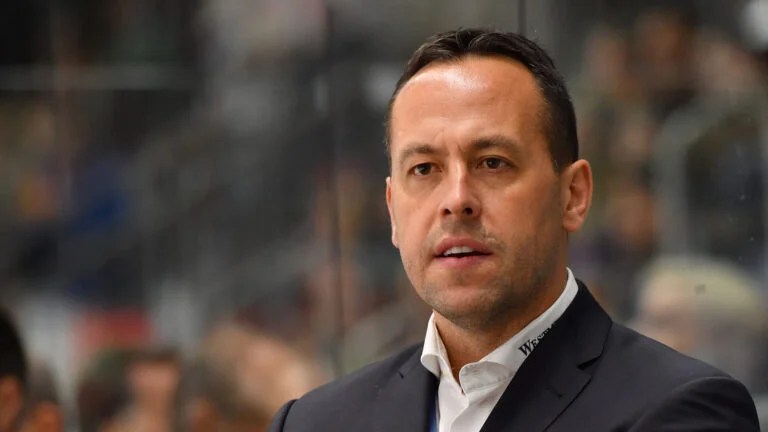
The Boston Bruins have officially named Marco Sturm as their 30th head coach, ushering in a new era for the franchise. Sturm, a former Bruins forward, returns to Boston with a wealth of coaching experience, having spent the last three seasons leading the Ontario Reign, the AHL affiliate of the Los Angeles Kings. His hiring signals a shift in strategy for the Bruins, who are looking to rebuild and reestablish their identity after a disappointing season.
In this blog post, we’ll take a deep dive into Sturm’s coaching history, his coaching style, and what his arrival means for the future of assistant coaches Jay Leach and Chris Kelly, as well as Joe Sacco’s next steps.
Marco Sturm’s transition from NHL player to head coach has been a fascinating journey. After retiring from professional hockey in 2013, Sturm quickly moved into coaching, starting with Germany’s national team. His tenure as head coach and general manager of the German Men’s National Team (2015-2018) was a defining moment in his career. Under his leadership, Germany achieved a historic silver medal at the 2018 PyeongChang Olympics, marking the country’s best-ever finish in Olympic hockey.
Following his success on the international stage, Sturm joined the Los Angeles Kings as an assistant coach (2018-2022). His time in Los Angeles was pivotal, as he helped develop young talent and contributed to the Kings’ return to the Stanley Cup Playoffs in 2022. In 2022, Sturm took over as head coach of the Ontario Reign, where he led the team to three consecutive playoff appearances and compiled an impressive 119-80-11-6 record.
Now, Sturm brings his experience and leadership to Boston, where he will be tasked with revitalizing a struggling Bruins squad.
Sturm’s coaching philosophy is rooted in discipline, structure, and player development. His teams have consistently displayed strong defensive fundamentals, a trait that aligns well with the Bruins’ traditional identity. However, Sturm also emphasizes offensive evolution, something Bruins GM Don Sweeney highlighted as a key factor in his hiring.
Key Aspects of Sturm’s Coaching Style:
Defensive Responsibility: Sturm’s teams prioritize structured defensive play, limiting high-danger scoring chances and maintaining tight gaps in the neutral zone.
Player Development: He has a proven track record of developing young talent, as seen with the Ontario Reign and Germany’s national team.
Communication & Leadership: Sturm is known for his ability to connect with players, earning their respect through clear communication and a strong work ethic.
Balanced Offense: While defense remains a priority, Sturm has worked to evolve offensive strategies, ensuring his teams can generate consistent scoring opportunities.
With Sturm taking over as head coach, the future of assistant coaches Leach and Kelly remains a topic of discussion. Leach, who recently returned to the Bruins after serving as an assistant coach for the Seattle Kraken, is expected to play a key role in developing the Bruins’ defense. His experience working with young defensemen in Providence and Seattle makes him a valuable asset to Sturm’s staff.
Kelly, who has been an assistant coach with the Bruins since 2021, is likely to remain in his role, focusing on special teams and forward development. His familiarity with the organization and strong rapport with players will be beneficial as the Bruins transition under Sturm’s leadership.
While Leach and Kelly are expected to stay, their specific roles and responsibilities may shift as Sturm implements his coaching philosophy.
Sacco, who served as the Bruins’ interim head coach following Jim Montgomery’s dismissal, will not be returning to Boston. Instead, Sacco is joining the New York Rangers’ coaching staff, where he will work under Mike Sullivan. His move to New York marks the end of his 12-year tenure with the Bruins, during which he played a crucial role in developing the team’s penalty kill and defensive strategies.
Sacco’s departure is significant, as he was a longtime fixture behind the Bruins’ bench. However, his new opportunity with the Rangers allows him to continue coaching at the NHL level while contributing to a new system and culture.
As the 2025-26 NHL season approaches, Bruins fans will be eager to see how Sturm’s coaching philosophy translates to on-ice success. Will he be able to restore the Bruins’ competitive edge and lead them back to the Stanley Cup Playoffs? Only time will tell, but one thing is certain—Boston is embracing a new direction, and Marco Sturm is at the helm.


 Dom - Hockey