The Boston Bruins endured a season that will likely be remembered for all the wrong reasons by ownership, management, players, and fans alike. Several factors contributed to the team’s struggles: the Jeremy Swayman contract dispute, a lack of preparation among players and coaches heading into training camp, a midseason coaching change, injuries to key defensemen, underwhelming performances on both the power play and penalty kill, and inconsistent coaching decisions. It was a season marred by challenges across the board.
In truth, the challenges extended beyond the factors already mentioned. Virtually everything seemed to go awry for the Bruins, with the notable exceptions of standout performances from David Pastrnak and Morgan Geekie.
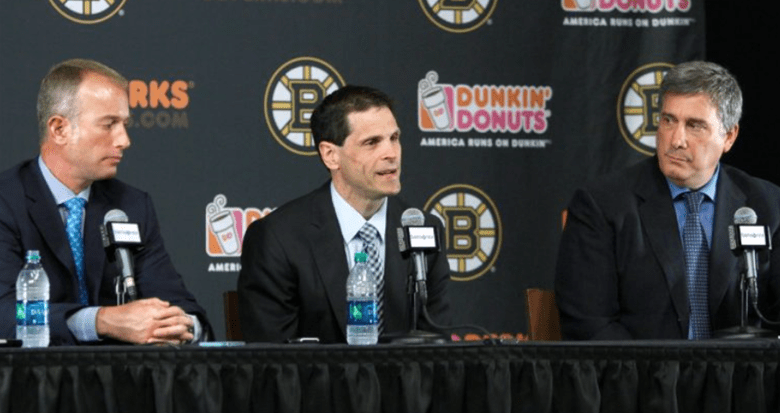
CEO Charlie Jacobs, President Cam Neely, and General Manager Don Sweeney have indicated that the organization is not pursuing a complete rebuild but rather a strategic retooling with a focus on future development. This approach was initiated at the trade deadline with the departure of Trent Frederic, Justin Brazeau, Charlie Coyle, Brandon Carlo, Max Jones and Brad Marchand—players who brought significant experience and leadership to the team.
Marat Khusnutdinov, Casey Mittelstadt, Henri Jokiharju, Jakub Lauko, along with prospects Fraser Minten and Will Zellers, and several draft picks, were brought into the organization. As a result, the Bruins rapidly transformed into one of the youngest teams in the NHL.
THE LONG LIST OF THINGS TO DO
The foremost priority is addressing the coaching situation, including decisions regarding Interim Head Coach Joe Sacco and assistant coaches Jay Leach and Chris Kelly. Ideally, the coaching staff should be established prior to free agency, with completion before the draft being even more advantageous. Ensuring that incoming players align with the coach’s vision is essential, as reversing this process may inadvertently exclude even the most qualified coaches from consideration.
Sacco has been a dedicated and reliable contributor to the Bruins organization over the years; however, a fresh perspective is needed to guide decision-making moving forward. The defensive unit, under Leach’s direction, has struggled throughout the season, showing signs of disorganization even more pronounced than last year when the blueliners lacked a dedicated coach behind the bench. Although injuries to key players like Hampus Lindholm and Charlie McAvoy impacted the team, the blueline appeared disoriented on most nights.
While Kelly has been an asset to the organization, his strengths may lie outside the realm of coaching from an NHL bench. Placing him in a developmental role focused on nurturing forward prospects alongside Adam McQuaid could better leverage his skills. Currently, the Bruins lack personnel in this specific role, and Kelly has the potential to excel in it.
The next priority for management is determining which restricted free agents should receive qualifying offers. Extending offers to Geekie and Mason Lohrei are straightforward decisions, requiring little deliberation. However, careful evaluation is necessary when considering qualifying Khusnutdinov, Lauko, and John Beecher. Beecher’s inclusion on this list may come as a surprise, but his qualifying offer is $874,125. Management must weigh whether it is feasible to find a better replacement at that cost. The bottom six is in need of a reshuffling of the deck.
Additionally, there are eight prospects or AHL players in need of qualifying offers: Oliver Wahlstrom, Georgii Merkulov, John Farinacci, Jaxon Nelson, Trevor Kuntar, Daniil Misyul, and Ian Mitchell. Among these, Merkulov, Farinacci, and Kuntar are clear priorities for me. Michael Callahan, a Group 6 unrestricted free agent, could be a suitable option to retain as a seventh or eighth defenseman.
The next priority on the agenda is the NHL Draft, a critical event where the Bruins must avoid repeating past mistakes. Recognizing the importance of this process, the organization has conducted thorough evaluations of the top prospects, with Sweeney personally observing key players on multiple occasions. As the draft approaches and the Bruins’ draft position becomes finalized, I will provide a comprehensive analysis of potential candidates who may be available to them. Be sure to follow the blog so you don’t miss out.
The NHL Draft is not solely about selecting new talent; it also serves as a prime opportunity for initiating trades or laying the groundwork for future deals. The Bruins face several key decisions in this area. While the team lacks a high-end center, they possess an abundance of players capable of playing down the middle—perhaps even an excess—positioning them well to explore trade possibilities.
Assuming Elias Lindholm assumes the top-line center role alongside Geekie and David Pastrnak, the Bruins have numerous options to fill the remaining center positions. Mittlestadt, Mark Kastelic, and Pavel Zacha are all versatile players who can play center. Additionally, emerging prospects Fraser Minten and Matthew Poitras are poised to compete for roster spots. This depth may be further bolstered if the team selects a center in the draft who is prepared to contribute as early as next season.
Continuing on this topic, any trade discussions must inevitably include the goaltending situation. Opinions regarding Swayman are divided: one perspective advocates for trading him before his no-trade clause becomes effective, while the other views him as the long-term solution in goal. Personally, I believe Swayman would benefit from a reset during the offseason, positioning him for a strong return next season. However, the focus of trade deliberations shifts to Joonas Korpisalo, Brandon Bussi, and Michael DiPietro, where significant decisions must be made. For the latter two, the question becomes what to do with them as they are both scheduled to become unrestricted free agents.
As the next season approaches, Bussi, who will be 27, had an opportunity during training camp to showcase his potential but ultimately fell short of expectations. DiPietro, on the other hand, earned recognition as part of the AHL First All-Star Team and will be 26 at the season’s start. The Bruins must carefully evaluate whether these two players, who have formed one of the top duos in the AHL over the past two seasons, have a future within the organization. Should one or both not return, the team may need to explore options to bolster their goaltending roster.
Korpisalo made an interesting remark during interviews following the players’ exit meetings, stating, “I don’t think there’s any goalie in the league who’s comfortable playing only 20-25 games.” While this comment might initially appear indicative of a desire to leave, that was not the case in this instance. Nonetheless, it is advisable for the Bruins to explore trade opportunities for Korpisalo. Backup goaltenders may be available at a lower cost, and in a salary cap environment, even the smallest savings can be impactful. If the organization has confidence in either Bussi or DiPietro, then pursuing this move becomes imperative.
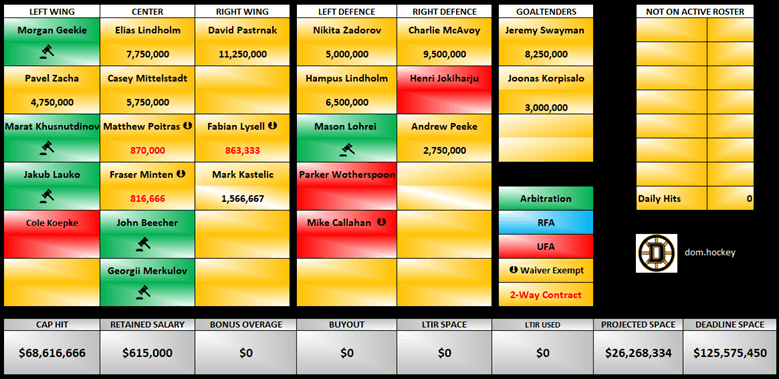
The next significant date on the calendar for the Bruins is the start of free agency, also known as Canada Day on July 1. With an estimated $26–28 million in cap space, depending on your roster configuration, the organization must allocate funds strategically. A portion of this cap space will be allocated towards securing new contracts for Geekie and Lohrei, with the goal of finalizing these agreements prior to July 1.
Following the trade deadline, I firmly believed it was essential for the Bruins to give Fabian Lysell an opportunity to play out the remainder of the season. This extended time at the NHL level would have allowed the organization to assess his capabilities to some extent. Such an evaluation seemed crucial before committing $30–40 million to a free agent, especially when the solution might have already been within their own system- eventually. Lysell showed improvement as time progressed, but the question remains—did he demonstrate enough to guide management in their decision-making process? Perhaps once the AHL playoffs conclude, the organization will have a clearer perspective.
A similar sentiment was expressed regarding Merkulov; however, he has now been surpassed by Poitras and Minten, with Dans Locmelis potentially ahead as well, should the Bruins choose to develop him as a center. Additionally, Farinacci has made significant strides, narrowing the gap between them. As a result, the most viable path for Merkulov appears to be at left wing, where he displayed immediate chemistry alongside Poitras—though Locmelis demonstrated an even better connection in that position as well.
The Bruins face several roster gaps that need to be addressed through free agency. Depending on their evaluation of Lysell, they may have one or two openings for right-wing positions behind Pastrnak. While it is theoretically possible to move Geekie back to his natural position on the right wing, doing so would exacerbate the existing need for a top-line left-wing player. If Lysell is slated for the third line, the Bruins will require a second-line right-winger, as there are no viable options available within Providence’s ranks. This should be a key area of focus for the team as they explore solutions.
If Geekie continues in the top-line left-wing role and Zacha is permanently shifted to left wing, the Bruins will face the need to address two left-wing positions—one on the third line and one on the fourth line. As previously mentioned, the bottom-six forwards require a significant overhaul. While Lauko and Khusnutdinov remain under control as restricted free agents with arbitration rights, there is room for improvement in their roles. Upgrading these positions through free agency should be an area for the team to explore.
One of the most intriguing developments to watch will be the situation on the blue line, which will largely hinge on the health of Lindholm and McAvoy. While the Bruins have promising prospects in Providence, including Frederic Brunet, Jackson Edward, and Ty Gallagher, none are ready for NHL-level responsibilities just yet—though Brunet seems the most advanced among them. This raises another key question: what will it cost to bring Lohrei back into the fold?
The primary question centers on who will secure the second-pair right defense position. Jokiharju emerges as the leading candidate following an impressive performance at the Four Nations tournament and a strong conclusion to the season after his acquisition from Buffalo. He currently carries a $3.1 million cap hit and is slated to become an unrestricted free agent on July 1. It is worth noting that the team is still retaining $615,000 of Brandon Carlo’s cap hit, the former Bruin who occupied this position. While there are some intriguing options available in the free agent market, few align with a long-term strategic outlook.
It has been suggested elsewhere that Sweeney freed up significant cap space at the trade deadline in preparation for next season. However, it is important to clarify that the actual cap space cleared was minimal. Frederic, Brazeau, and Marchand were already set to come off the books, meaning their cap hits were not part of any additional savings. In fact, Mittelstadt’s salary is $500,000 higher than Coyle’s, resulting in a net increase in that area. The only notable savings came from the Jones trade and his $1,000,000 and $3,485,000 cleared by moving Carlo’s cap hit. However, given the potential costs of his replacement, particularly when factoring in salary retention, these savings may be offset. Ultimately, the $7.5 million increase in the salary cap far exceeds the amount actually cleared at the trade deadline for the upcoming season.
The method by which the cap space was achieved is irrelevant; what truly matters is that it is now available. The manner in which it is utilized during this offseason will be critical in determining whether this becomes a swift and effective retooling effort with a forward-looking approach, or whether it results in a missed opportunity.
Outlined below is the Bruins’ cap situation for the upcoming offseason. It is important to note that the players listed are not necessarily projected to be part of the final roster. For cap purposes, the team must have a minimum of 20 players listed, either signed or classified as restricted free agents with arbitration rights.


 Dom - Hockey
Do you sign Parker Wotherspoon next year again. He played a lot of hockey at a bargain price?
LikeLike